GLOBAL VILLAGE KIDS Rural
A funding program within the framework of Kultur macht stark. Alliances for Education
The GLOBAL VILLAGE KIDS program facilitates projects at the interface of the liberal performing arts and cultural education. The program has two funding priorities: artistic projects in rural areas and artistic projects in digital areas.
The GLOBAL VILLAGE KIDS program's funding priority in rural areas is intended to support projects aimed at children and young people aged 3 to 18, especially those in social, financial or educational risk situations, children and young people with disabilities, and children and young people with refugee experience. The program is looking for artistic projects whose approach in the various genres and branches of the liberal performing arts provides new and age-appropriate access to art and culture, addressing both local and global issues. The program focus is intended to support and expand basic cultural services for children and youth in rural areas. In addition, independent local art and cultural actors benefit and can increase their visibility through the projects.
With the program "Kultur macht stark. Bündnsisse für Bildung," the German Federal Ministry of Education and Research has been funding extracurricular cultural education projects for children and young people who have little access to them since 2013. 27 program partners from the fields of education, culture, and social services implement the program and support local projects applied for by alliances for education or carry them out together with local partners. The German Federal Ministry of Education and Research provides up to 50 million euros annually for this purpose, thus contributing to more educational opportunities in Germany. You can find out more about the program and how to apply here: www.buendnisse-fuer-bildung.de.
What is supported?
Funding is provided for artistic (also hybrid, analog and digital) projects that are either open in format or, depending on the project period, open-ended, as well as artistic-participative work approaches with children and young adults between 3 and 18 years in high-risk situations, children and young adults with handicaps as well as children and young adults with refugee experience with short-, mid- and long-term project periods. The funding modules include short-term laboratory projects with a period of a maximum of 3 months up to one-year process projects as well as long-term conceptual projects for outstanding and pioneering approaches in the field of performing arts and cultural education, which may extend over a period of up to two years. Laboratory funding is recommended for new alliances, for example. After successful laboratory funding, an existing alliance can apply for further process or conceptual funding. Within laboratory funding, as a rule no performances are expected. This funding is especially recommended for alliances with no previous experience. After a successful laboratory support, an already existing alliance can apply for a continued process or concept support. In process funding, performances can be part of the process. In concept support, performances – if suitable, numerous performances – should be part of the work process.
Who can apply?
Alliances of at least 3 partners from art/culture, education and society. All alliance partners must be organized as legal entities (for example, as a “Verein”, an institution in public or private hands, GmbH, etc.) or as a “GbR” and have its address and work focus in Germany.
Eligible to apply from the alliance are: protagonists of all genres and departments of the independent performing arts (performance, theater, dance, music theater, puppet and object theater, theater in public space, contemporary circus, digital performing arts, among others). Individuals are not eligible to apply, but can be alliance partners. All alliance partners provide own contributions.
How much can be applied for?
The application sum for GLOBAL VILLAGE KIDS Rural is at least 5.000 € and a maximum of 100.000 €. Within the project periods for short-, mid- and long-term funding, the application sum is divided as follows:
For laboratory support, the application sum is at least 5.000 € and a maximum of 20.000 €.
For process support, the application sum is at least 20.000 € and a maximum of 60.000 €.
For concept support, the application sum is at least 60.000 € and a maximum of 100.000 €.
This is full financing.
Application and funding deadlines
The next application deadline is 01.10.2023 (project start date 01.01.2024 at the earliest).
The process and conception funding for 2024/2025 will be announced exclusively on 01.10.2023. Conceptual funding can only be applied for after prior consultation with the GLOBAL VILLAGE KIDS project office. Please arrange a consultation appointment in due time.
The possible project duration for approved projects depends on the requested format. It begins with the positive funding approval and ends:
- for projects starting in 2024, no later than Dec. 31, 2024 (laboratory and process funding) / Dec. 31, 2025 (concept funding).
Complete proofs of use must be submitted no later than four weeks after the end of the respective project. In the case of projects spanning more than one year, an interim report must be submitted at the end of each year.
Further assistance is provided by the regulations, FAQs and the completion guide for online applications. There will be several information events on the program during each application period.
Prevention and child protection
Projects funded by GLOBAL VILLAGE KIDS are committed to sensitive, non-discriminatory and respectful interaction and to measures that protect underage participants from all forms of violence, especially sexualized violence. With the application deadline of March 1, 2024, it must be ensured in the event of funding that the alliances inspect and document the extended certificates of good conduct of all persons who have direct and regular contact with participating children and young people.
As the inspection of extended certificates of good conduct is only one component of comprehensive protection measures, further steps are also required, in particular a protection concept.
Information on this can be found here:
- Website of the Independent Commissioner for Child Sexual Abuse Issues of the Federal Government with extensive help and prevention offers: https://beauftragte-missbrauch...
- Exemplary protection concept of the Federal Association for Cultural Child and Youth Education: www.bkj.de/publikation/dachverbandliches...
The most important facts at a glance
- An alliance consisting of at least three alliance partners, all of whom are organized as legal entities, is eligible to apply. GbRs are also formally eligible to apply.
- The alliances and the honorary staff involved should be as local as possible.
- Funding is available for projects that work with children and young people between the ages of 3 and 18 who are at risk, with children and young people who have experienced flight, and with children and young people with disabilities.
- This is a full funding.
- Only artistic work and related expenses done directly with children and youth are eligible.
- More detailed information and calculation aids can be found in the guidelines.
Forms
All necessary information provided in the section forms.
Consultation
If you have any questions about the GLOBAL VILLAGE KIDS funding program, please contact Eva Stöhr and Marlene Kunath. We will be happy to advise you before you apply.
Advice via mail:
eva.stoehr*fund-daku.de
marlene.kunath*fonds-daku.de
Advice via phone:
030 6293126-52
GLOBAL VILLAGE KIDS is a funding program of the Fonds Darstellende Künste, supported by the Federal Ministry of Education Research within the framework of "Kultur macht stark. Bündnisse für Bildung".
Jury
-
Irina-Simona Bârcă
Dramaturge, theater mediator | Berlin
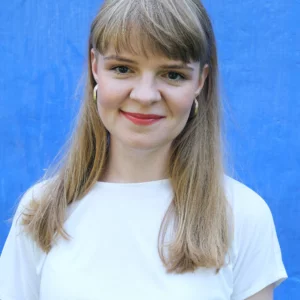 © privat
Irina-Simona Bârcă
Dramaturge, theater mediator | BerlinIrina-Simona Bârcă is a dramaturge and mediator. Born and raised in Romania, she studied acting in Bucharest and theater pedagogy at Osnabrück University of Applied Sciences. After working in Münster and Berlin, she was a dramaturge at the FFT (Forum Freies Theater) in Düsseldorf from 2017 to 2024, where she was responsible for the Young FFT section, including the programmatic focus "The Theater of Digital Natives". She has worked with pulk fiktion, Ives Thuwis, subbotnik, Leute wie die, machina eX and PINSKER + BERNHARDT, among others. She is part of various juries in German-speaking countries (Spielarten NRW, kicks! Theaternetzwerk Schweiz, Landesbüro freie darstellende Künste NRW) and was a member of the board of trustees at the Augenblick mal! 2021. As a lecturer, she gives seminars and training courses. Since January 2024, she has been Head of Artistic Mediation and Participation at Theater an der Parkaue.
-
Sarah Fartuun Heinze
Freelance artist*, author*, cultural educator* | Hamburg
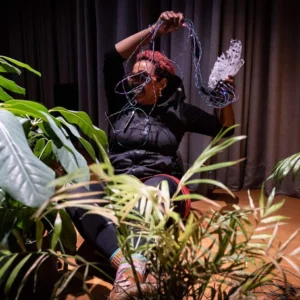 © Claudia Friedrich
Sarah Fartuun Heinze
Freelance artist*, author*, cultural educator* | HamburgSarah Fartuun Heinze is a Black(-gender-)Queer*Feminist; (wage) works as a freelance artist & author & cultural educator:multiverse(neurodiverse) &/ world changer:with theatre, games, Music and Empowerment, sees itself as an aesthetic researcher, is part of the Creative Gaming initiative and the Neue Deutsche Medienmacher.
Whether as a theater maker*, aesthetic researcher*, theater game designer*, musician*, as part of the Creative Gaming initiative or the New German Media Makers, as an author*, dramaturg* or cultural educator*: digital and analogue Basically, games have always moved Sarah Fartuun Heinze – and still do.
Her favorite game is: Zelda: Ocarina of Time, probably because the key to most of the puzzles is the music. As so often, far away from screens and (theater) stages.
-
Micha Kranixfeld, M.Sc.
Cultural Scientist | University of Koblenz-Landau
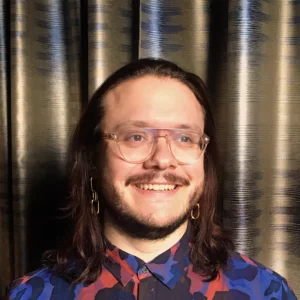 © Tony Franz
Micha Kranixfeld, M.Sc.
Cultural Scientist | University of Koblenz-LandauMicha Kranixfeld works as an artist and cultural scientist. He is a member of the syndicate Gefährliche Liebschaften (Dangerous Liaisons) and the Frl. Wunder AG (Miss Wunder AG), with whom he develops research-based art projects in social fields. In the process, he creates wanderings into the future of work, colorful evenings about meat, or radio plays about the queerness of rural spaces. As a cultural scientist, Micha Kranixfeld conducts research at the University of Koblenz on social art in rural areas and images of rural diversity.
-
Beata Anna Schmutz
Dramaturg, director | Mannheim
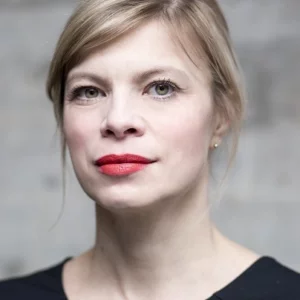 © Felix Grünschloß
Beata Anna Schmutz
Dramaturg, director | MannheimBeata Anna Schmutz was born in Gdansk, Poland in 1975. After studying German at the University of Gdańsk, she continued her university education in the subjects of art history, educational science and literature at the Ruprecht Karls University in Heidelberg. She is the artistic director of numerous theater, art and media education projects and was a cultural education employee at the Haus der Jugend Heidelberg from 2005 to 2016, where she headed the art and theater departments. Freelance director and dramaturg since 2006, university lecturer in the fields of aesthetic education, post-dramatic theater and performance. In 2005 she founded the theater and performance group RAMPIG, where she works as a director and dramaturg. From 2016 to 2018 she was head of the Volkstheater department at the Badisches Staatstheater Karlsruhe. Since 2018 she has been directing the Mannheim City Ensemble at the National Theater Mannheim. Member of the board of the Dramaturgical Society since 2016.
-
Irina-Simona Bârcă
Dramaturge, theater mediator | Berlin
© privat
Irina-Simona Bârcă
Dramaturge, theater mediator | BerlinIrina-Simona Bârcă is a dramaturge and mediator. Born and raised in Romania, she studied acting in Bucharest and theater pedagogy at Osnabrück University of Applied Sciences. After working in Münster and Berlin, she was a dramaturge at the FFT (Forum Freies Theater) in Düsseldorf from 2017 to 2024, where she was responsible for the Young FFT section, including the programmatic focus "The Theater of Digital Natives". She has worked with pulk fiktion, Ives Thuwis, subbotnik, Leute wie die, machina eX and PINSKER + BERNHARDT, among others. She is part of various juries in German-speaking countries (Spielarten NRW, kicks! Theaternetzwerk Schweiz, Landesbüro freie darstellende Künste NRW) and was a member of the board of trustees at the Augenblick mal! 2021. As a lecturer, she gives seminars and training courses. Since January 2024, she has been Head of Artistic Mediation and Participation at Theater an der Parkaue.
-
Sarah Fartuun Heinze
Freelance artist*, author*, cultural educator* | Hamburg
© Claudia Friedrich
Sarah Fartuun Heinze
Freelance artist*, author*, cultural educator* | HamburgSarah Fartuun Heinze is a Black(-gender-)Queer*Feminist; (wage) works as a freelance artist & author & cultural educator:multiverse(neurodiverse) &/ world changer:with theatre, games, Music and Empowerment, sees itself as an aesthetic researcher, is part of the Creative Gaming initiative and the Neue Deutsche Medienmacher.
Whether as a theater maker*, aesthetic researcher*, theater game designer*, musician*, as part of the Creative Gaming initiative or the New German Media Makers, as an author*, dramaturg* or cultural educator*: digital and analogue Basically, games have always moved Sarah Fartuun Heinze – and still do.
Her favorite game is: Zelda: Ocarina of Time, probably because the key to most of the puzzles is the music. As so often, far away from screens and (theater) stages.
-
Micha Kranixfeld, M.Sc.
Cultural Scientist | University of Koblenz-Landau
© Tony Franz
Micha Kranixfeld, M.Sc.
Cultural Scientist | University of Koblenz-LandauMicha Kranixfeld works as an artist and cultural scientist. He is a member of the syndicate Gefährliche Liebschaften (Dangerous Liaisons) and the Frl. Wunder AG (Miss Wunder AG), with whom he develops research-based art projects in social fields. In the process, he creates wanderings into the future of work, colorful evenings about meat, or radio plays about the queerness of rural spaces. As a cultural scientist, Micha Kranixfeld conducts research at the University of Koblenz on social art in rural areas and images of rural diversity.
-
Beata Anna Schmutz
Dramaturg, director | Mannheim
© Felix Grünschloß
Beata Anna Schmutz
Dramaturg, director | MannheimBeata Anna Schmutz was born in Gdansk, Poland in 1975. After studying German at the University of Gdańsk, she continued her university education in the subjects of art history, educational science and literature at the Ruprecht Karls University in Heidelberg. She is the artistic director of numerous theater, art and media education projects and was a cultural education employee at the Haus der Jugend Heidelberg from 2005 to 2016, where she headed the art and theater departments. Freelance director and dramaturg since 2006, university lecturer in the fields of aesthetic education, post-dramatic theater and performance. In 2005 she founded the theater and performance group RAMPIG, where she works as a director and dramaturg. From 2016 to 2018 she was head of the Volkstheater department at the Badisches Staatstheater Karlsruhe. Since 2018 she has been directing the Mannheim City Ensemble at the National Theater Mannheim. Member of the board of the Dramaturgical Society since 2016.
-
Katharina Warda
Soziologin, Literaturwissenschaftlerin | Berlin
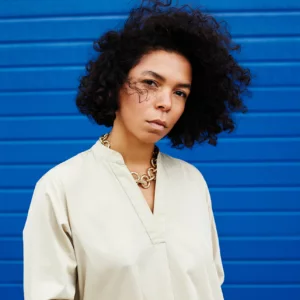 © Alena Schmick
Katharina Warda
Soziologin, Literaturwissenschaftlerin | BerlinKatharina Warda ist Soziologin und Literaturwissenschaftlerin. Warda arbeitet als freie Autorin mit Schwerpunktthemen Ostdeutschland, marginalisierte Identitäten, Rassismus, Klassismus und Punk. Seit 2021 ist sie Beiratsmitglied von „Kein Schlussstrich!“, einem bundesweiten Theaterprojekt zum NSU-Komplex. In ihrem Projekt Dunkeldeutschland erkundet sie die Nachwendezeit von den sozialen Rändern aus und beleuchtet blinde Flecken in der deutschen Geschichtsschreibung, basierend auf ihren eigenen Erfahrungen als Schwarze ostdeutsche Frau in der DDR und nach 1989/90.
-
Irina-Simona Bârcă
Dramaturge, theater mediator | Berlin
© privat
Irina-Simona Bârcă
Dramaturge, theater mediator | BerlinIrina-Simona Bârcă is a dramaturge and mediator. Born and raised in Romania, she studied acting in Bucharest and theater pedagogy at Osnabrück University of Applied Sciences. After working in Münster and Berlin, she was a dramaturge at the FFT (Forum Freies Theater) in Düsseldorf from 2017 to 2024, where she was responsible for the Young FFT section, including the programmatic focus "The Theater of Digital Natives". She has worked with pulk fiktion, Ives Thuwis, subbotnik, Leute wie die, machina eX and PINSKER + BERNHARDT, among others. She is part of various juries in German-speaking countries (Spielarten NRW, kicks! Theaternetzwerk Schweiz, Landesbüro freie darstellende Künste NRW) and was a member of the board of trustees at the Augenblick mal! 2021. As a lecturer, she gives seminars and training courses. Since January 2024, she has been Head of Artistic Mediation and Participation at Theater an der Parkaue.
-
Juliane Barz
Theater mediator | Magdeburg
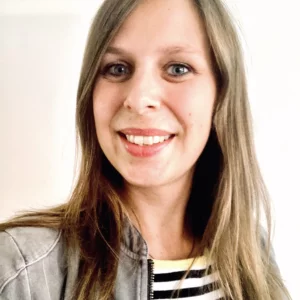 © privat
Juliane Barz
Theater mediator | MagdeburgJuliane Barz studied educational science and theater studies in Hildesheim and trained as a theater pedagogue (BuT) in Berlin. Most recently, she was employed at the Puppentheater Magdeburg for four years. Since September 2022, she has been working as a freelance theater mediator, director and production/project manager - including for the BANDE '23 format at Schauspielhaus Magdeburg and for the Moritzhof's socio-cultural district project "#moritz4all". In her work, she constantly explores new interfaces with other arts and media as well as new forms, formats and spaces and negotiates sustainable topics using a research-based and empowering approach. She is also involved as a spokesperson for the Arbeitskreis Ost for children's and youth theater, as part of the Adultism working group and on the Magdeb Cultural Advisory Boardurg.
-
Katrin Breschke
Project management FLUX Theater und Schule | Frankfurt am Main
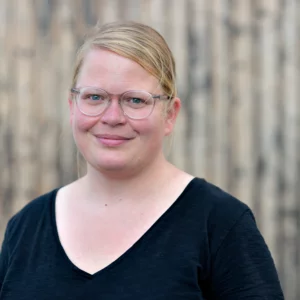 © Ulrich Herding
Katrin Breschke
Project management FLUX Theater und Schule | Frankfurt am MainKatrin Breschke studied German, Romance languages and literature and philosophy at the TU Dresden and then dramaturgy at the Hessian Theater Academy. She worked as a dramaturg at the Theater und Philharmonisches Orchester Heidelberg, at the state theaters in Nuremberg and Braunschweig and most recently at the Staatsschauspiel Dresden. From 2017 to 2020, she was a member of the Performing Arts Working Group at the Office for Culture and Monument Protection of the City of Dresden. Since 2020, she has been one of three project managers at FLUX - Netzwerk Theater und Schule, a program to promote cultural participation in rural areas in Hesse. She also works as a freelance dramaturg at the Stadttheater Ingolstadt and the Hessisches Landestheater Marburg, among others. For the 2022 and 2023 festival editions of the Hessian Children's and Youth Theater Week KUSS at the Landestheater Marburg, she was part of the selection committee for the productions of the AK-Südwest.
-
Tessa Hart
Kulturmacher!n & Kulturwand(l)er!n | Berlin
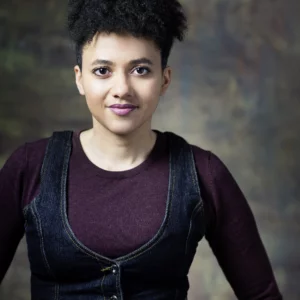 © Caroline Wimmer
Tessa Hart
Kulturmacher!n & Kulturwand(l)er!n | BerlinTessa Hart is a culture maker & culture changer in performing arts, film & socio-cultural fields and has lived in Berlin, Brussels and London. Tessa is currently responsible for the project & artistic direction of "AfroPolitan" Berlin as well as the artistic direction of the production company "Goblin Baby Co." and is a regular member of selection committees and juries, such as the Max Ophüls Preis film festival or the IKARUS nomination jury (children's & youth theater prize). Tessa has also been involved in numerous performance, film and cultural projects, from artistic to mediating to organizational, and co-founded and co-directed the Bread & Roses Theatre in London for seven years. Tessa writes, curates, directs, performs, mediates, organizes, researches, invents, moderates, lectures, accompanies, moves and does whatever else comes up.
-
Christopher Weymann
Performer, computer scientist and theater maker | Hamburg
 © Daniel Ladner
Christopher Weymann
Performer, computer scientist and theater maker | HamburgChristopher Weymann (he/him) is a queer-feminist performer, computer scientist and theater maker for a transgenerational audience. At FUNDUS THEATER / Forschungstheater in Hamburg, he realizes projects and productions in co-creation with children and young people in the field of tension between society, science and art. With the preamble "Everything that is binary must be hacked!" he develops digital instruments and theater prototypes for the participatory deconstruction of heteronormative, classist and adultist power systems.
-
Irina-Simona Bârcă
Dramaturge, theater mediator | Berlin
© privat
Irina-Simona Bârcă
Dramaturge, theater mediator | BerlinIrina-Simona Bârcă is a dramaturge and mediator. Born and raised in Romania, she studied acting in Bucharest and theater pedagogy at Osnabrück University of Applied Sciences. After working in Münster and Berlin, she was a dramaturge at the FFT (Forum Freies Theater) in Düsseldorf from 2017 to 2024, where she was responsible for the Young FFT section, including the programmatic focus "The Theater of Digital Natives". She has worked with pulk fiktion, Ives Thuwis, subbotnik, Leute wie die, machina eX and PINSKER + BERNHARDT, among others. She is part of various juries in German-speaking countries (Spielarten NRW, kicks! Theaternetzwerk Schweiz, Landesbüro freie darstellende Künste NRW) and was a member of the board of trustees at the Augenblick mal! 2021. As a lecturer, she gives seminars and training courses. Since January 2024, she has been Head of Artistic Mediation and Participation at Theater an der Parkaue.
-
Juliane Barz
Theater mediator | Magdeburg
© privat
Juliane Barz
Theater mediator | MagdeburgJuliane Barz studied educational science and theater studies in Hildesheim and trained as a theater pedagogue (BuT) in Berlin. Most recently, she was employed at the Puppentheater Magdeburg for four years. Since September 2022, she has been working as a freelance theater mediator, director and production/project manager - including for the BANDE '23 format at Schauspielhaus Magdeburg and for the Moritzhof's socio-cultural district project "#moritz4all". In her work, she constantly explores new interfaces with other arts and media as well as new forms, formats and spaces and negotiates sustainable topics using a research-based and empowering approach. She is also involved as a spokesperson for the Arbeitskreis Ost for children's and youth theater, as part of the Adultism working group and on the Magdeb Cultural Advisory Boardurg.
-
Katrin Breschke
Project management FLUX Theater und Schule | Frankfurt am Main
© Ulrich Herding
Katrin Breschke
Project management FLUX Theater und Schule | Frankfurt am MainKatrin Breschke studied German, Romance languages and literature and philosophy at the TU Dresden and then dramaturgy at the Hessian Theater Academy. She worked as a dramaturg at the Theater und Philharmonisches Orchester Heidelberg, at the state theaters in Nuremberg and Braunschweig and most recently at the Staatsschauspiel Dresden. From 2017 to 2020, she was a member of the Performing Arts Working Group at the Office for Culture and Monument Protection of the City of Dresden. Since 2020, she has been one of three project managers at FLUX - Netzwerk Theater und Schule, a program to promote cultural participation in rural areas in Hesse. She also works as a freelance dramaturg at the Stadttheater Ingolstadt and the Hessisches Landestheater Marburg, among others. For the 2022 and 2023 festival editions of the Hessian Children's and Youth Theater Week KUSS at the Landestheater Marburg, she was part of the selection committee for the productions of the AK-Südwest.
-
Nils Deventer
Experience, theater and media pedagogue | Berlin
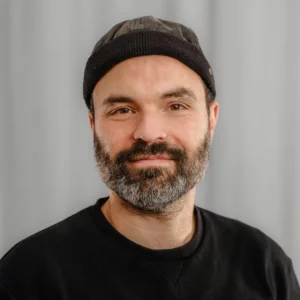 © Mediale Pfade Jason Krüger
Nils Deventer
Experience, theater and media pedagogue | BerlinAfter completing his master's degree in theater pedagogy at the Berlin University of the Arts in 2012, Nils Deventer worked for the Schauspielhaus Hamburg, the Junges Schauspielhaus Düsseldorf and the Theater an der Parkaue Berlin. During this time, he gained extensive experience in the curation, conception and realization of participatory projects and participation formats of various types and sizes. After his projects increasingly dealt with topics of the digital world, he moved to medialepfade.org e.V. in 2021, where he is now part of the management team for the nationwide educational program "Jugend hackt".
-
Tessa Hart
Kulturmacher!n & Kulturwand(l)er!n | Berlin
© Caroline Wimmer
Tessa Hart
Kulturmacher!n & Kulturwand(l)er!n | BerlinTessa Hart is a culture maker & culture changer in performing arts, film & socio-cultural fields and has lived in Berlin, Brussels and London. Tessa is currently responsible for the project & artistic direction of "AfroPolitan" Berlin as well as the artistic direction of the production company "Goblin Baby Co." and is a regular member of selection committees and juries, such as the Max Ophüls Preis film festival or the IKARUS nomination jury (children's & youth theater prize). Tessa has also been involved in numerous performance, film and cultural projects, from artistic to mediating to organizational, and co-founded and co-directed the Bread & Roses Theatre in London for seven years. Tessa writes, curates, directs, performs, mediates, organizes, researches, invents, moderates, lectures, accompanies, moves and does whatever else comes up.